Encounters
Encounter Mechanics
Encounters layer a card battle on top of the rhythm game: you and an opponent trade damage automatically as notes are judged, each side backed by a five-card loadout. Accuracy still decides your score — but your deck decides whether you survive. This page collects the measured formulas behind it all.
Balance note (v1.0.4, September 18, 2026): official patch notes reduced the difficulty of certain late-arc Encounters that were, in lowiro's words, “incorrectly more difficult than intended”. If a late-arc encounter feels easier than guides describe, confirm you're on v1.0.4 first — full patch notes in the version tracker.
Card Loadout
Before each Encounter you slot up to five cards, one per Phase, and no two cards from the same Blueprint. Empty slots fall back to 100 Power / 100 Defense. The opponent's loadout is preset per Encounter, so it can be scouted and countered.
Total Power/Defense = (Sum of Card stats) × Difficulty Multiplier, where Difficulty Multiplier = 1.00 + Level × 0.05
Higher chart levels multiply your stats — a Level 10 chart runs at ×1.50. The opponent's totals use the same math without the difficulty multiplier.
Color Advantage
Each color beats exactly one other in a five-way cycle. A card holding the advantage over the opposing Phase card gains ×1.25 Power and Defense; the disadvantaged side is unaffected — advantage only ever works in one direction.
Resolve & Phases
Resolve is each side's health bar; the goal is to empty the opponent's while keeping yours above zero. A chart splits into five Phases by note count (each fifth of total notes judged starts the next), activating the next card in your loadout along with its Traits. In Story Encounters, dropping below 0 Resolve ends the run immediately; in Music Play you always play to the end.
Maximum Resolve = Total Defense
Defense is survivability: your starting Resolve equals your loadout's total Defense.
Damage per Note
| Side | Judgement | Damage |
|---|---|---|
| You → opponent | EXACT | Total Power ÷ Total notes |
| You → opponent | NEAR | 0.5 × EXACT |
| You → opponent | BREAK | 0 |
| Opponent → you | EXACT / NEAR | Opponent Power ÷ Total notes |
| Opponent → you | BREAK | 5 × EXACT (critical) |
You also carry a Resonance gauge: EXACT notes fill it (about 80% of a Phase's notes worth), NEARs and BREAKs do nothing. Once full, everything you deal for the rest of the Phase becomes a ×5 critical. The gauge empties when a new Phase begins — so bank your accuracy early in each Phase.
Encounter Score
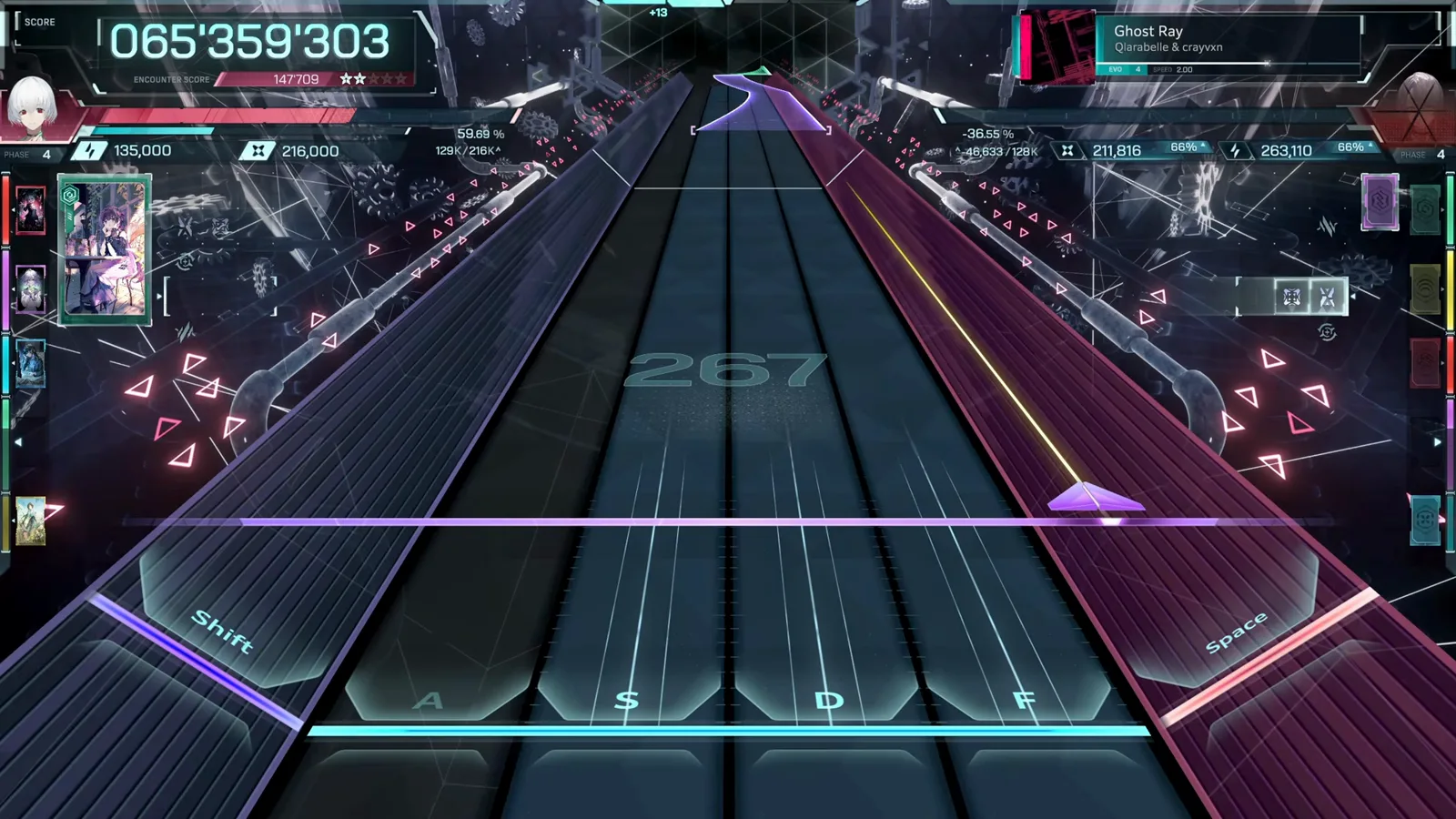
A second scoring axis, independent of the accuracy score: it compares your damage-times-Resolve product against the opponent's, then scales by the Encounter's Difficulty Rating. Dealing more, tanking less and recovering Resolve all push it up.
Encounter Score = [Damage × (Initial + Recovered Resolve)]Player ÷ [Damage × (Initial + Recovered Resolve)]Opponent × Difficulty Rating × 100
Damage dealt counts both note and Trait damage on each side.

Star Thresholds
| Stars | Encounter Score |
|---|---|
| 0.2 ★ | 2,000 |
| 0.4 ★ | 4,000 |
| 0.6 ★ | 6,000 |
| 0.8 ★ | 8,000 |
| 1.0 ★ | 10,000 |
| 1.2 ★ | 20,000 |
| 1.4 ★ | 40,000 |
| 1.6 ★ | 60,000 |
| 1.8 ★ | 80,000 |
| 2.0 ★ | 100,000 |
| 2.2 ★ | 200,000 |
| 2.4 ★ | 400,000 |
| 2.6 ★ | 600,000 |
| 2.8 ★ | 800,000 |
| 3.0 ★ | 1,000,000 |
| 3.2 ★ | 2,000,000 |
| 3.4 ★ | 4,000,000 |
| 3.6 ★ | 6,000,000 |
| 3.8 ★ | 8,000,000 |
| 4.0 ★ | 10,000,000 |
| 4.2 ★ | 20,000,000 |
| 4.4 ★ | 40,000,000 |
| 4.6 ★ | 60,000,000 |
| 4.8 ★ | 80,000,000 |
| 5.0 ★ | 100,000,000 |
Each full star costs ten times the previous one — jumping from 3★ to 4★ takes as big a multiplier as 0★ to 3★. Thresholds are community-measured and not yet officially confirmed.
Results & Rewards
An Encounter ends Connected when the opponent's Resolve is below zero and yours isn't. Iota only drop for a Connected result with Dive Cleared or better — and not in Music Play with Remembrance unlinked. Each Encounter draws from its own Iota pool with a capped drop Potency.
Try the loadout simulatorAct 4 boss encounter — out-sustaining the heal
Act 4's boss encounter (Chronophobia) is defined by one mechanic: the boss heals so much that any gap in your damage gets erased between phases, and a war of attrition is a lost cause. This section shares the community-verified card plan for beating the heal.
Written for infalsustips.com from our own demo testing and community research. Fact-checked against: In Falsus Wiki (Miraheze) (CC BY-SA 4.0) · In Falsus Wiki (Fandom) (CC BY-SA)
Data reflects demo v0.3.1 · being re-verified on 1.0 · Unofficial fan site — In Falsus © lowiro