Guide · Walkthrough
Card Integration, Build Your First Card
A hands-on companion to the Integration rules reference: follow one demo card from empty blueprint to Encounter payout — Iota placement, penalty dodging, Finalize and the Remembrance rewards loop. For the full rule tables, read the Integration page alongside.
Source
- [In Falsus] Card Integration and Remembrance Explained — TrappyTheDemon
Screenshots are frames from the linked video, credited above, recorded on the public demo. Menu names and numbers appear exactly as shown in that build; penalty multipliers match the wiki's measured table.
- 1
Open the Integration hub
From the character hub, the Integration panel counts everything the system uses — the demo save shows 2 Blueprints, 2 Cards and 234 loose Iota. Cards are the finished gear; Iota are the parts they are built from.
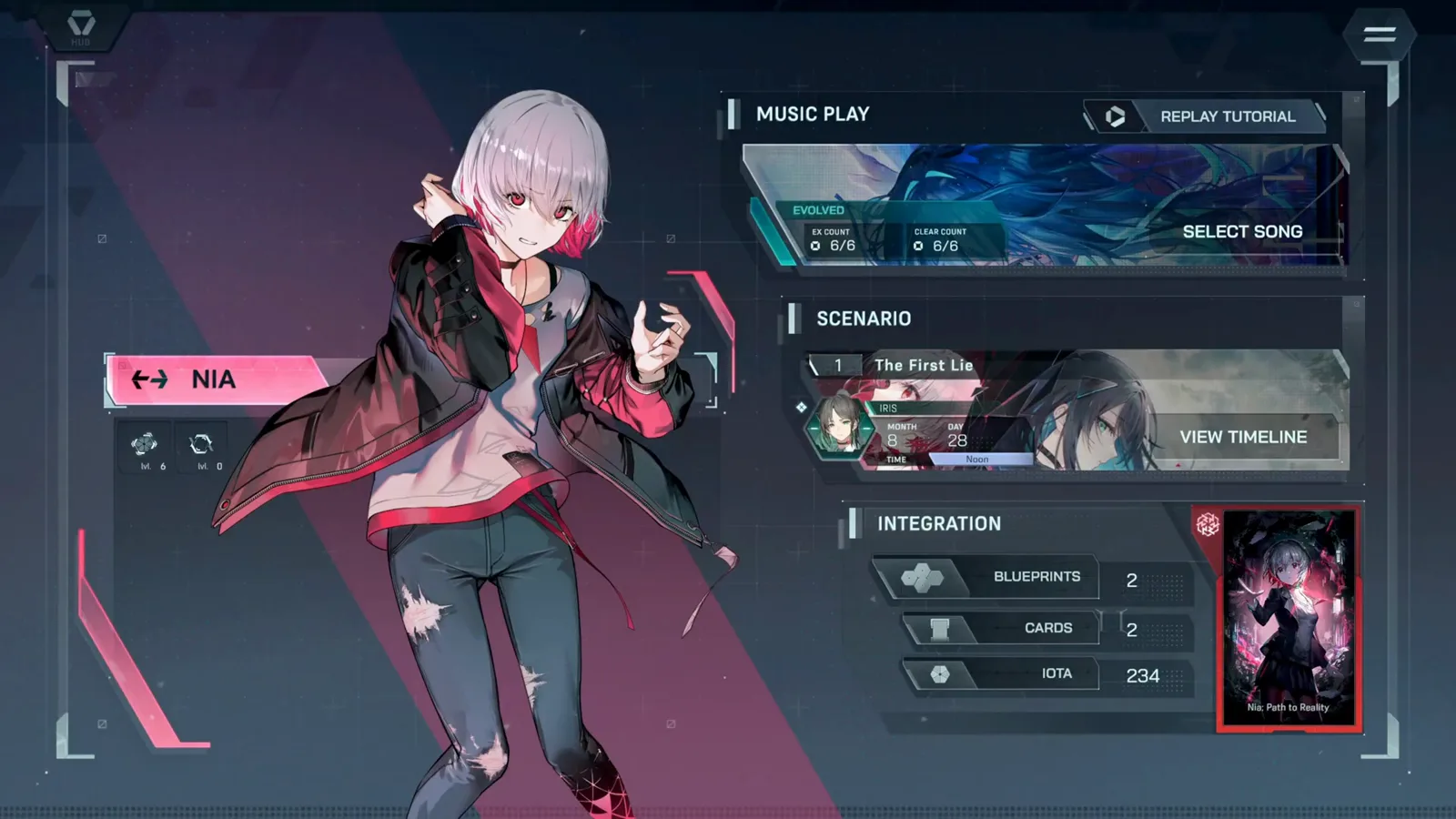
The hub's Integration panel: Blueprints 2, Cards 2, Iota 234.Watch source clip - 2
Pick a blueprint in the Blueprints tab
The Integration hub splits into Blueprints, Cards and Iota tabs. The demo ships 2 of the 50 planned cards — Mei: 4AM and Nia: Path to Reality — and each shows its Power and Defense right in the gallery.
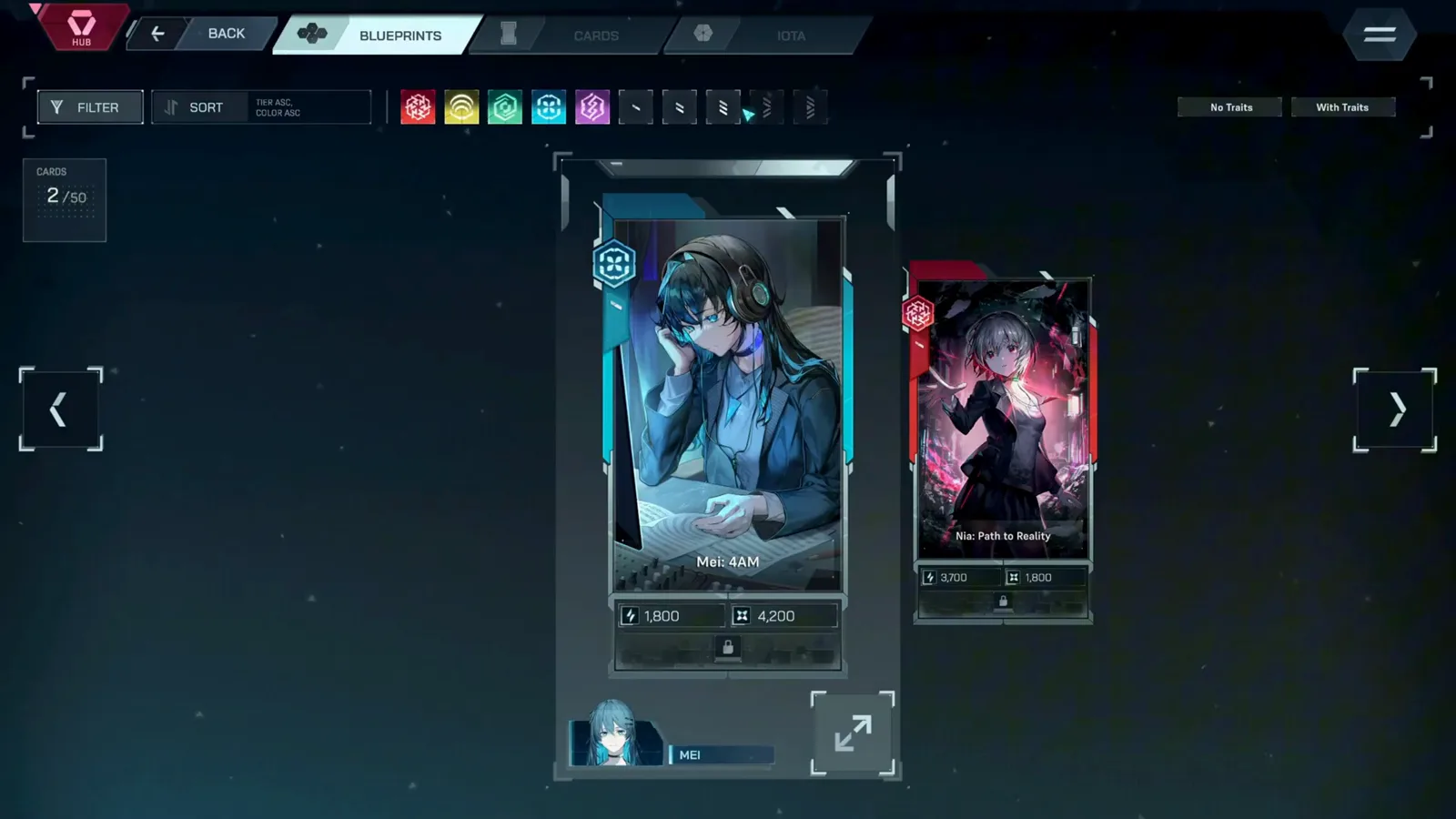
CARDS 2/50 — two demo cards, one per character.Watch source clip - 3
Read the Blueprint before placing anything
Integrating opens the hex blueprint. The left panel tracks Iota Used (this one caps at 4), Average Potency, the Potency Multiplier and all five penalty counters; the grid marks color zones with quotas, and the bottom tray lists every Iota you own with its potency.
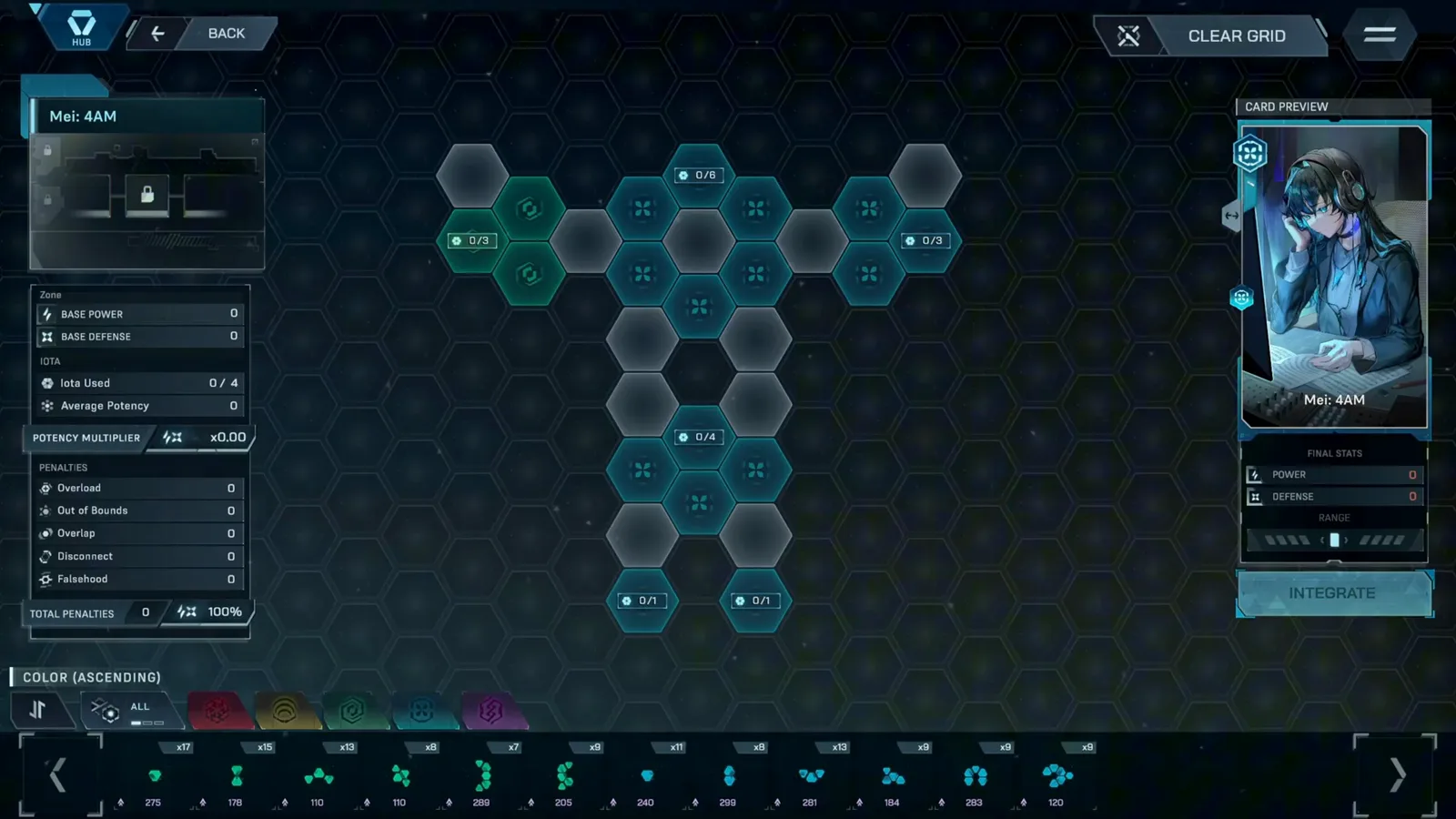
Everything at zero — the multiplier only moves once Iota hit the grid.Watch source clip - 4
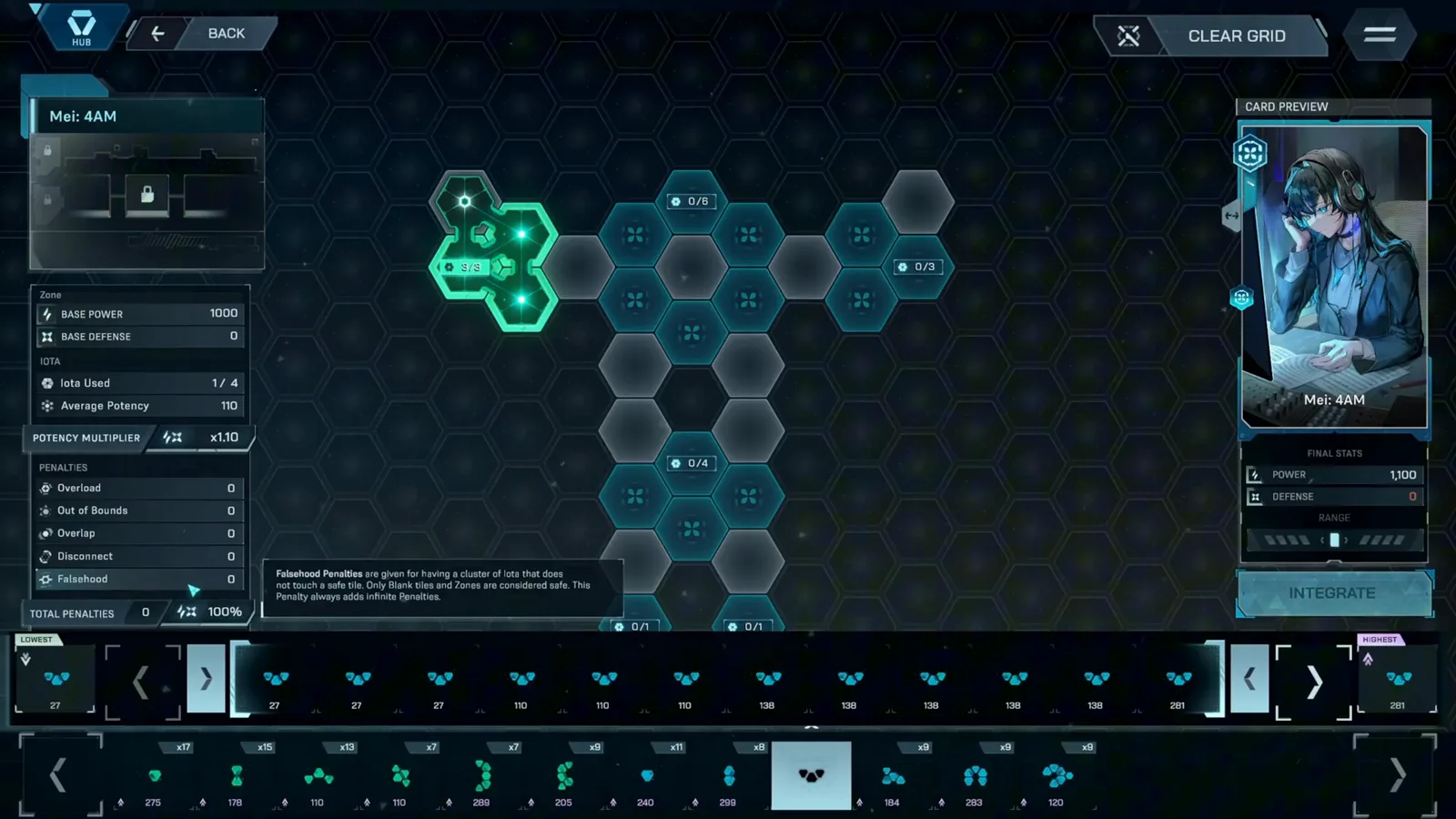
Place your first Iota and watch the math
Every Iota carries a potency number. Drop one worth 110 and Average Potency becomes 110; the multiplier is that average divided by 100, so x1.10 — and the card preview's Power climbs from a 1,000 base to 1,100.

One 110-potency Iota: Average Potency 110 → multiplier x1.10 → Power 1,100.Watch source clip - 5
First penalty: Overload
Placing more Iota than the limit allows earns one Overload penalty per extra Iota — here 5 placed on a 4-slot blueprint. Total penalties 1 already cuts the stat multiplier to 89%; integrating is still possible, just weaker.
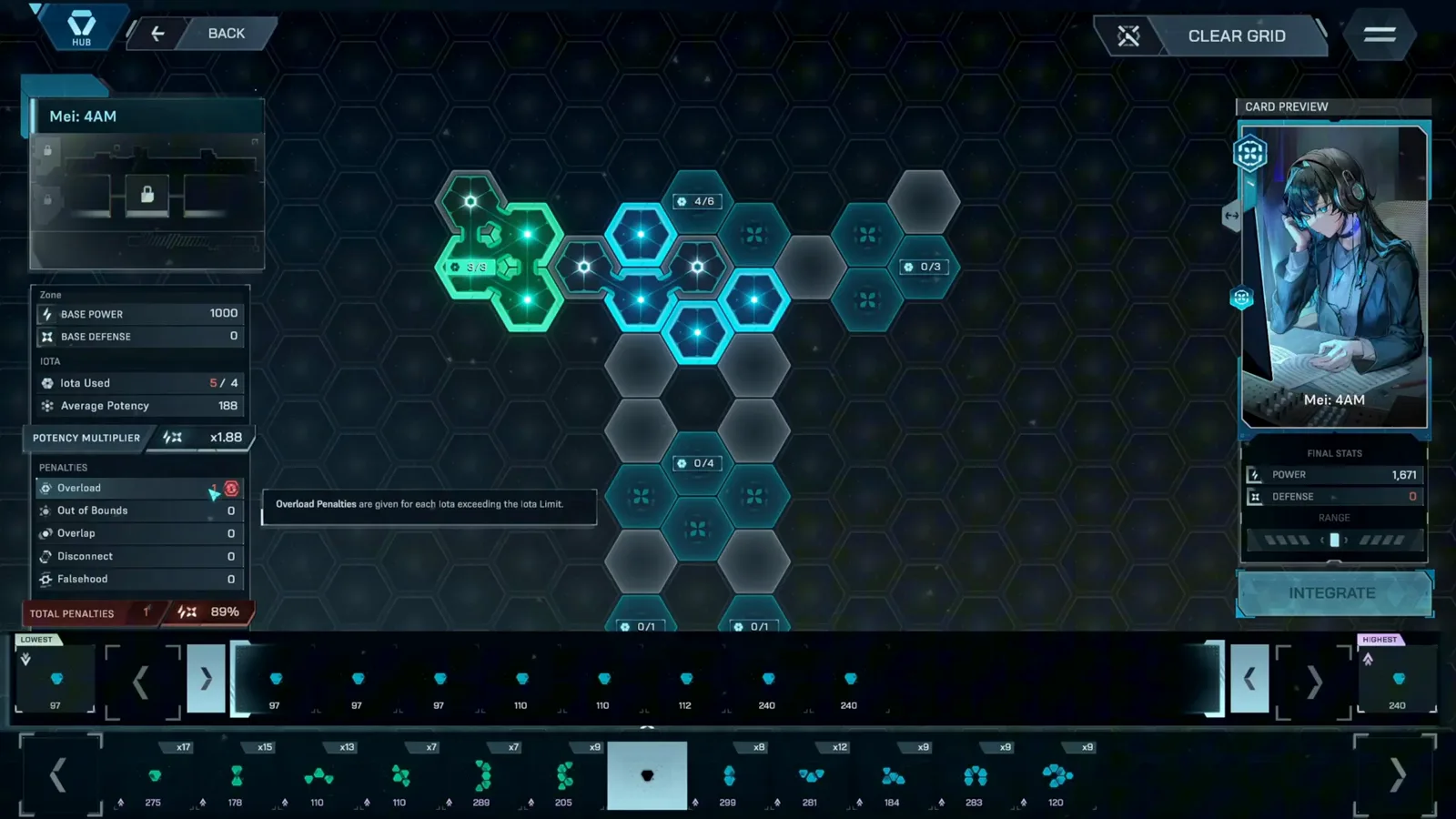
"Overload Penalties are given for each Iota exceeding the Iota Limit."Watch source clip - 6
The five penalties, and the lethal one
Overload, Out of Bounds, Overlap, Disconnect — each adds a point — and Falsehood: a cluster of Iota that touches no safe tile adds infinite penalties, zeroing the card. In the demo, some characters' skills forgive a set amount of specific penalties.
"Only Blank tiles and Zones are considered safe."Watch source clip - 7
Disconnect: keep the chain unbroken
Leaving an empty hex between clusters costs one Disconnect penalty per extra cluster. This build sits at Disconnect 1 — total penalties 1, multiplier back to 89%, and the Final Stats preview already reflects the drop.
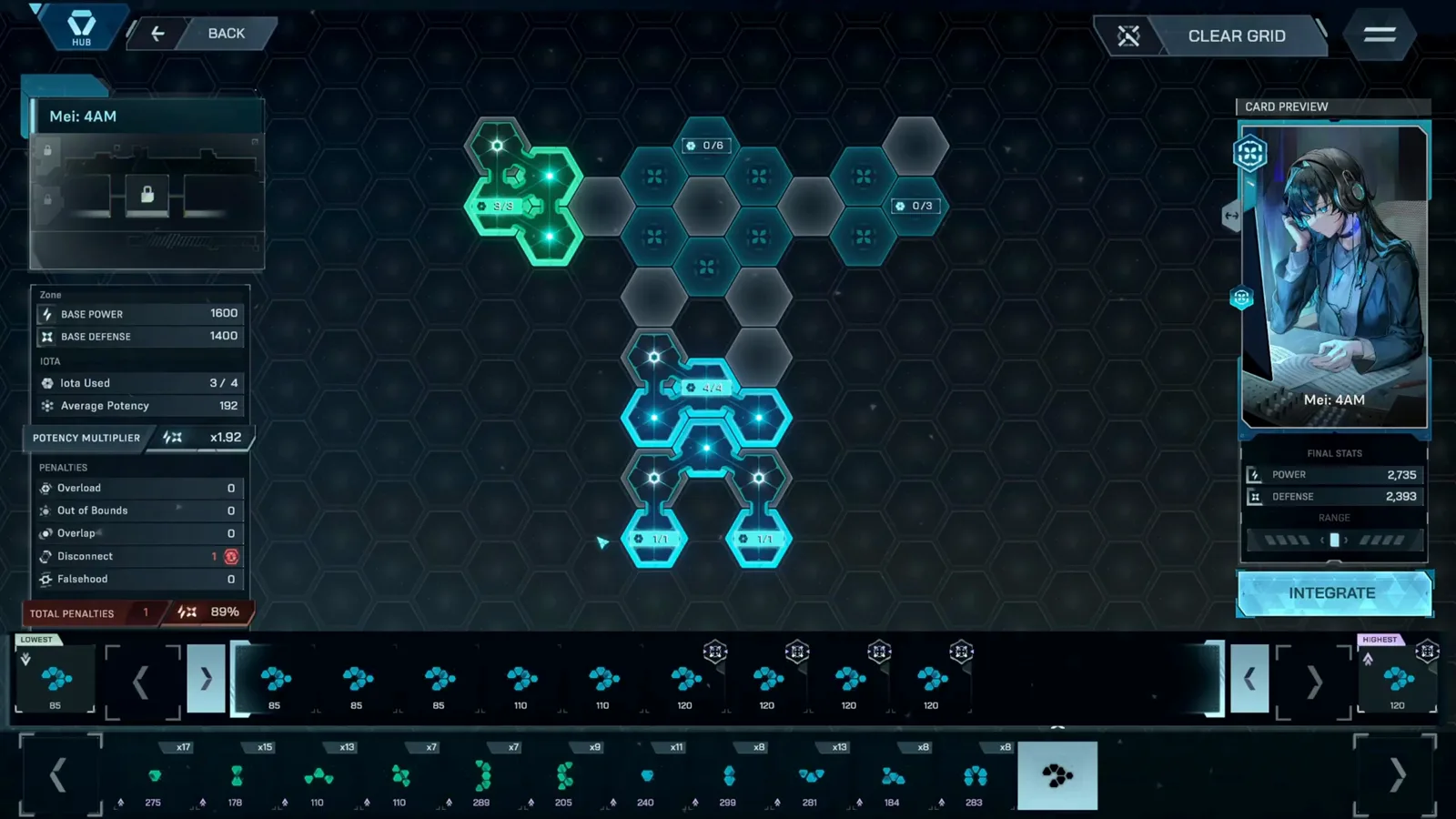
A gap in the chain is a penalty point; the Final Stats dip with it.Watch source clip - 8
Trait Iota add a combat perk
Some Iota come with traits. Hovering this build's trait shows Inner Rigor++ — "During this Card's Phase: Total DEF +66%" — which stacks on top of the raw stats: 4/4 Iota, Average Potency 174, multiplier x1.74, zero penalties.
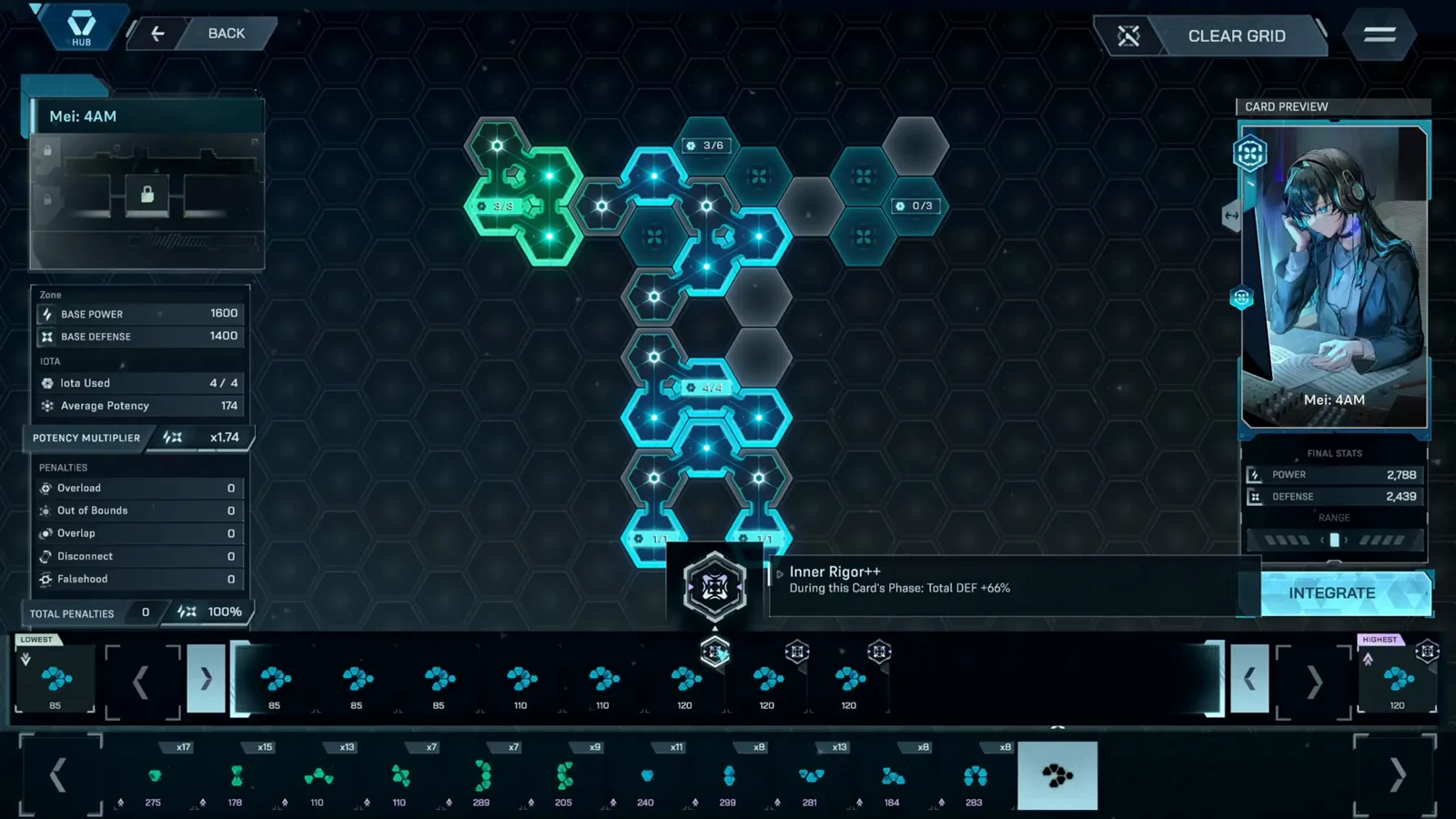
The finished Mei blueprint: 4 Iota, average potency 174, x1.74, penalties 0.Watch source clip - 9
Finalize the card
Hitting Integrate opens the Finalize Card screen — Available Traits on the left, the finished card previewed with its final Power and Defense, 2,788/2,439 here. One more Integrate press mints it.
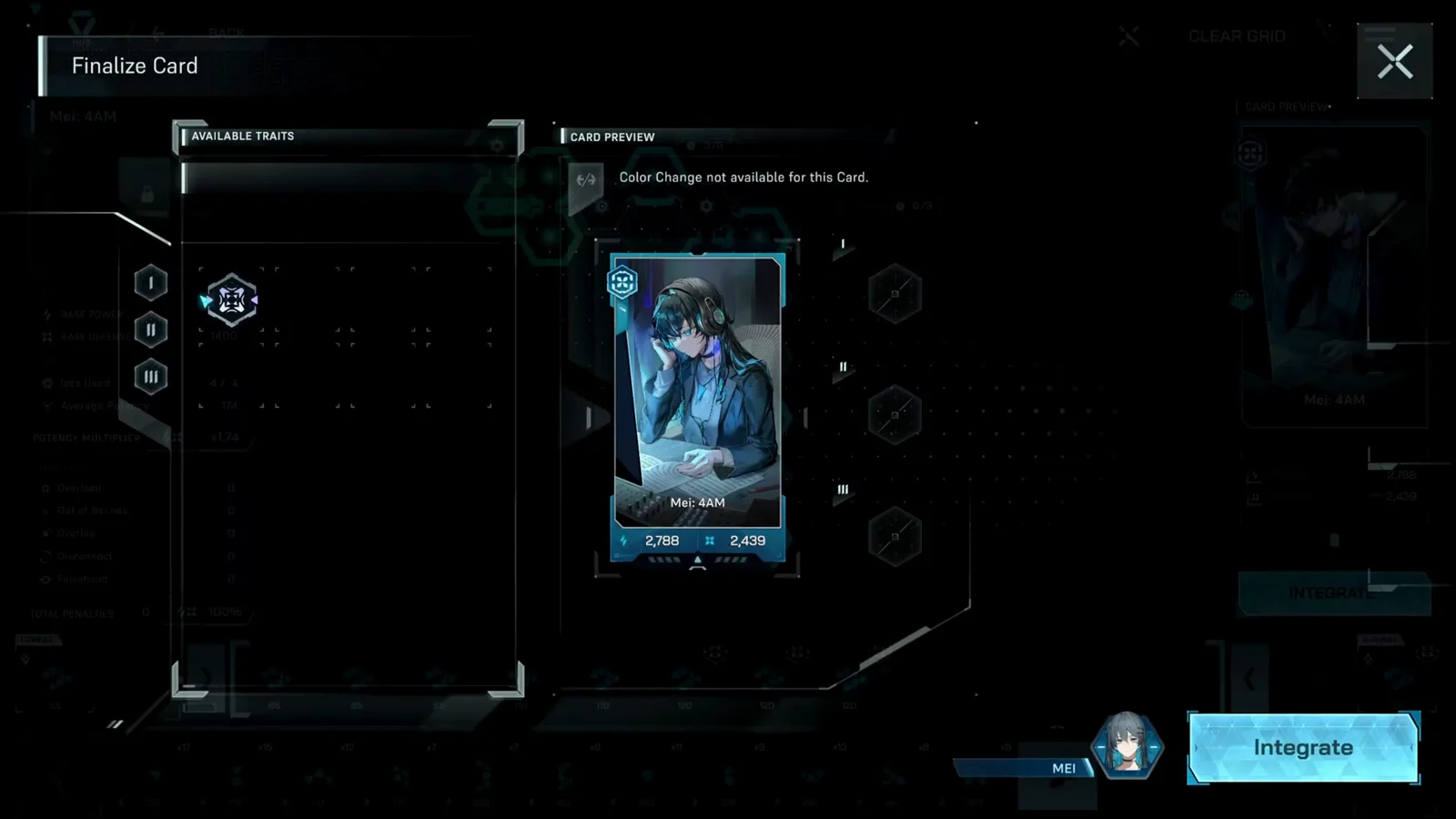
Finalize shows the exact card you will get — no surprises after minting.Watch source clip - 10
Compare against the old card
Back in the Cards gallery, the fresh Mei: 4AM (2,788 Power / 2,439 Defense) sits beside the starter copy (2,184/1,911). Same name, strictly better stats — that is Integration's whole job.
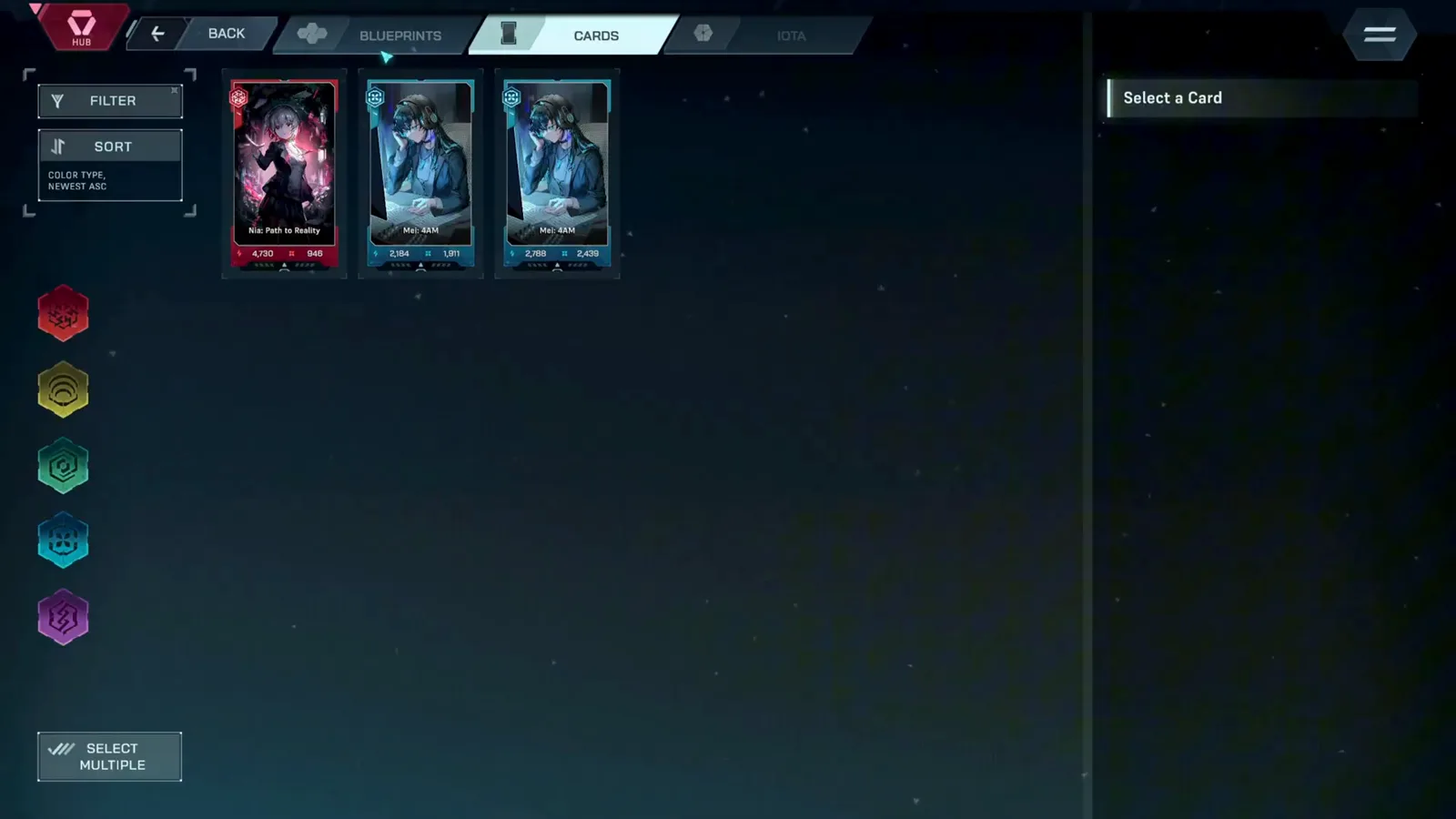
New vs old on one screen — the integrated card wins.Watch source clip - 11
Scale it up on the second character
Nia's blueprint goes to 6/6 Iota at an Average Potency of 259 — multiplier x2.59 with zero penalties — turning a 3,000 base Power into 7,760 final. Hovering a zone previews exactly what filling it grants, like +1,500 Power.
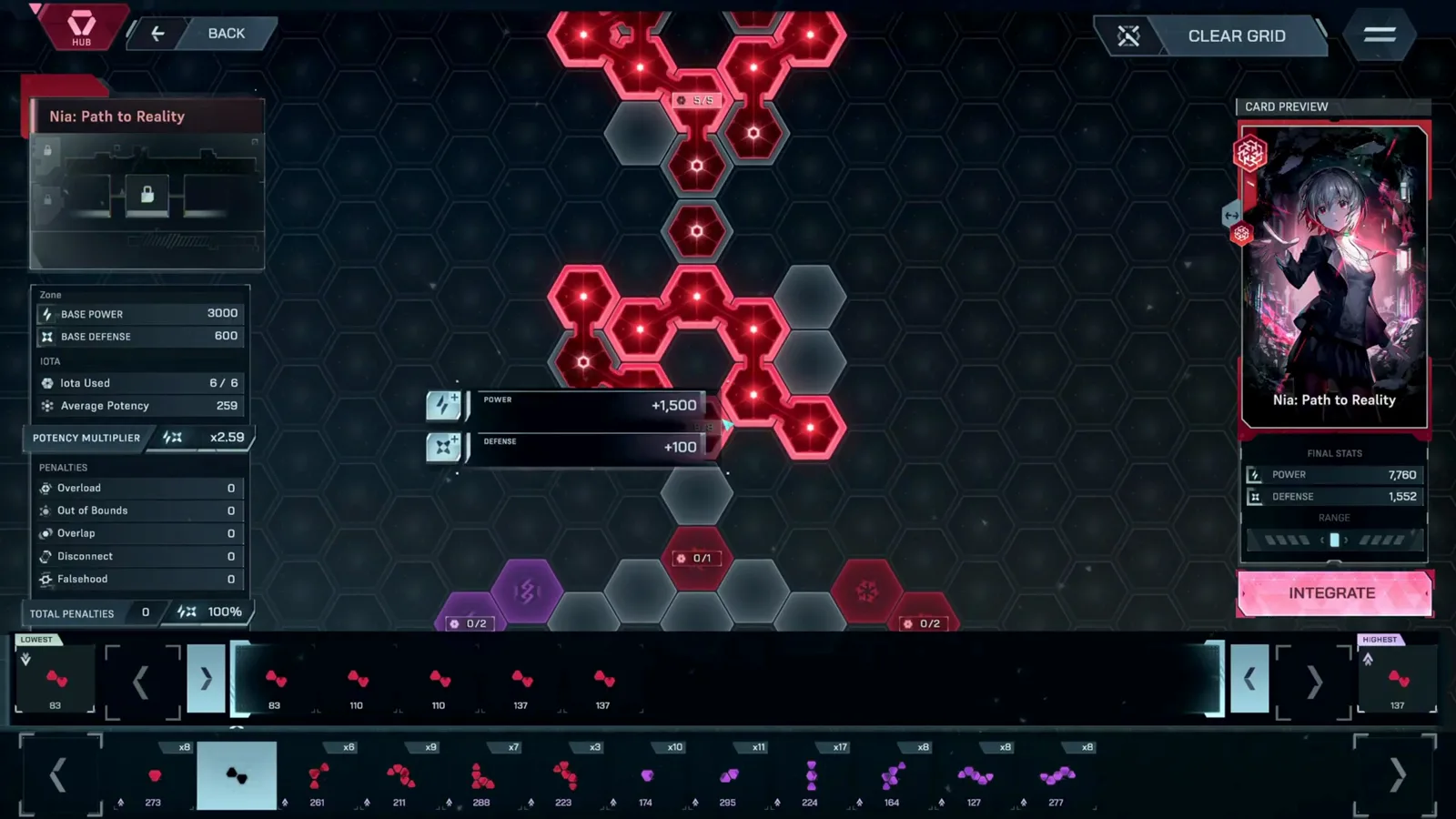
6 Iota, average 259, no penalties: Final Stats 7,760 Power / 1,552 Defense.Watch source clip - 12
Slot your cards for the Encounter
An Encounter screen shows the opponent's Total Power and Defense (700/1,000 here) and their five cards above your five card slots. The bottom row totals your side with the difficulty multiplier applied — x1.50 on this Uncle Dive run — and the Color Guide maps the advantage pairings.
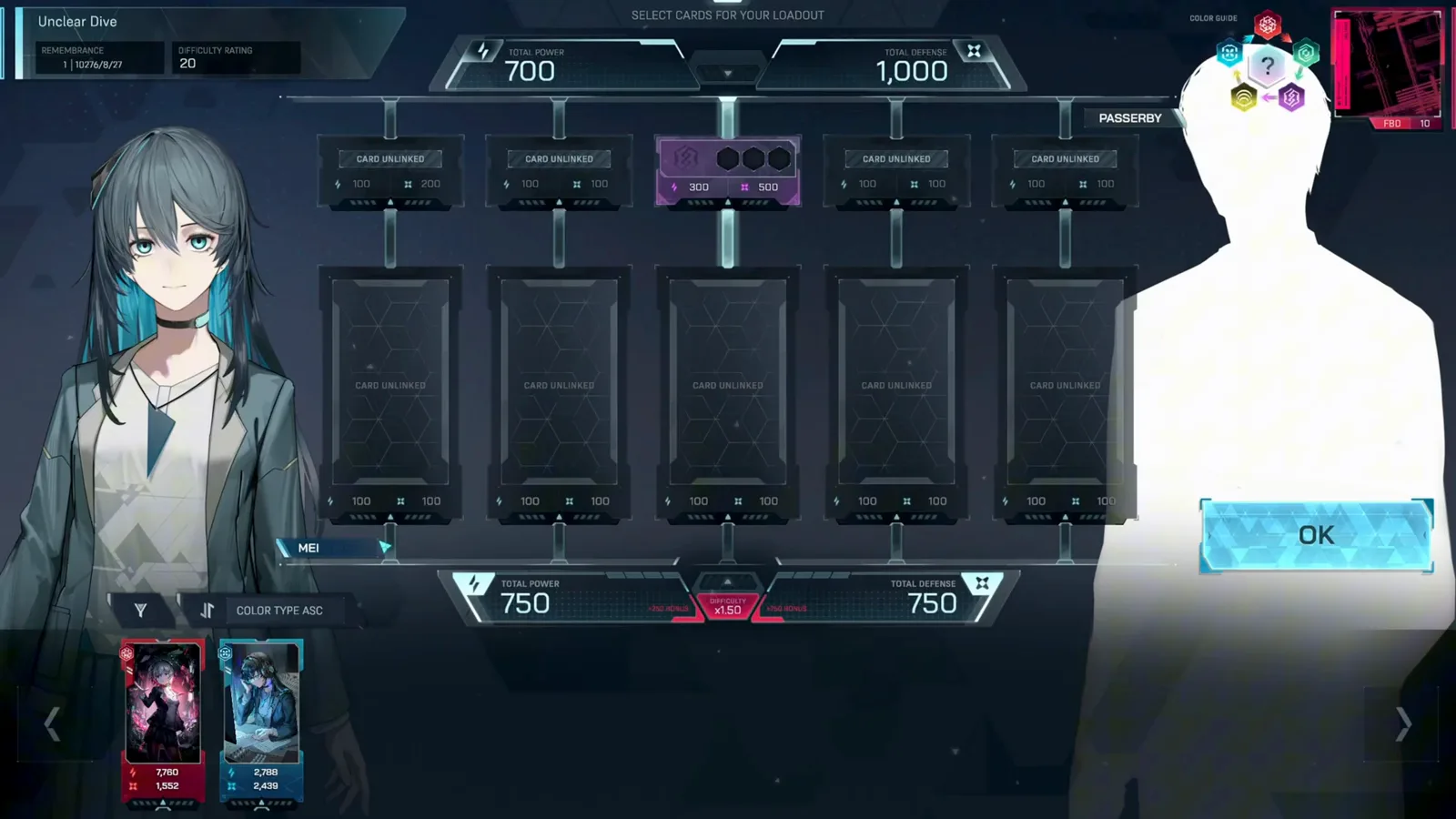
Two cards slotted: totals reach 16,272 Power / 6,437 Defense.Watch source clip - 13
Cards rotate on a countdown mid-dive
In-game, your slots hang on the left of the highway. The active card counts down, then the next takes over and its bonuses apply. Hit notes to fire at the enemy — but their damage to you never stops, so pick only difficulties where you land around EX/EX+.

Phase 1 of Ghost Ray: 20,228 Power against the Passerby's 2,200.Watch source clip - 14
Get paid in Iota
Finishing Connected with a clear pays out Iota — the result screen itemizes the drop and its sources, including Rank and Song Length bonuses. Those Iota go straight back into the blueprint for the next card.
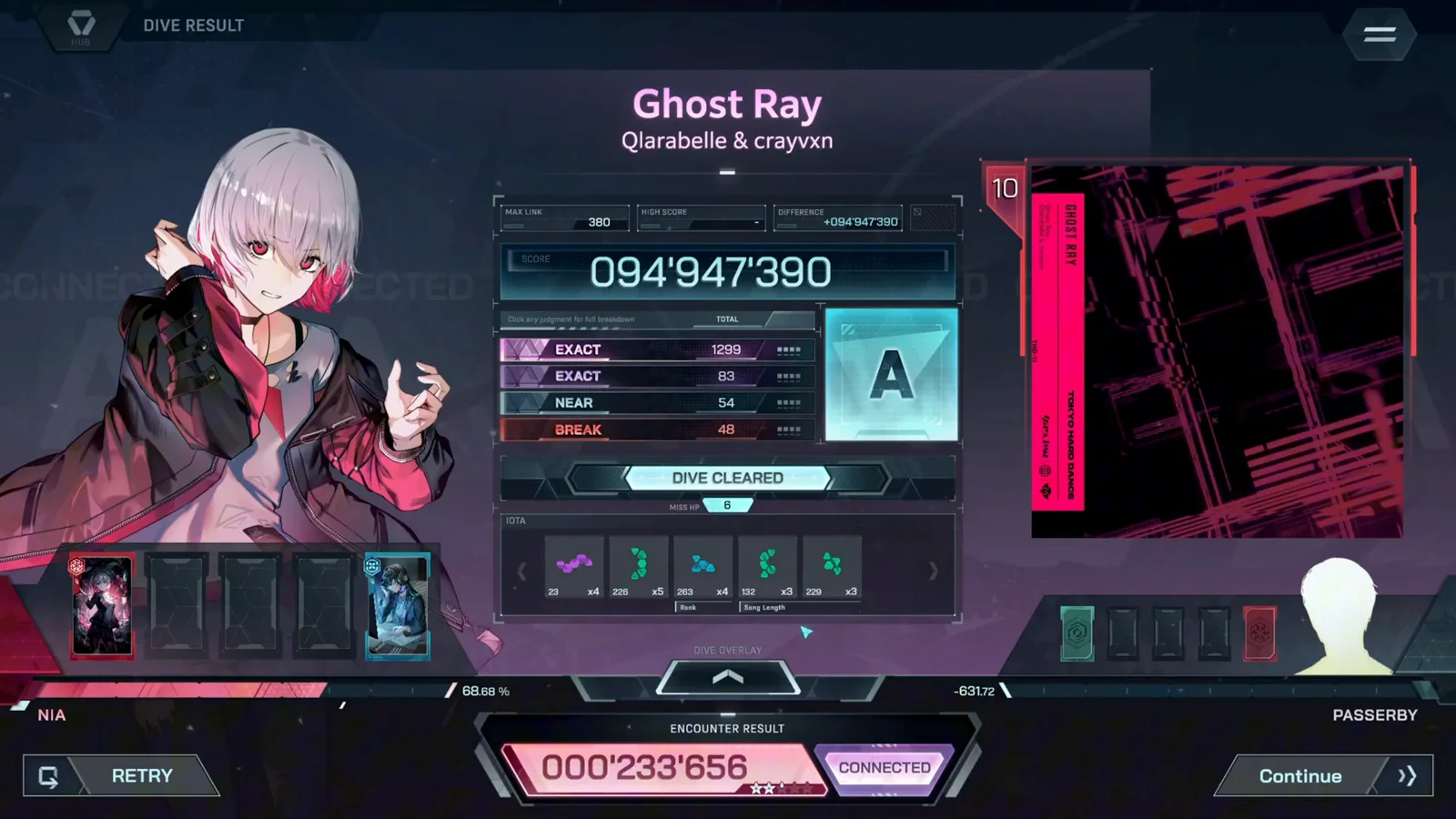
094'947'390, rank A, and five Iota stacks — the loop closes.Watch source clip
FAQ
How is the In Falsus potency multiplier calculated?
Average the potency of every placed Iota, then divide by 100. The walkthrough shows it live: one 110-potency Iota gives x1.10, a four-Iota build averaging 174 gives x1.74, and six Iota averaging 259 give x2.59. The multiplier scales the blueprint's base stats, and total penalties then cut the result — one penalty drops the card to 89%, two to 56%, three or more to zero.
How do I avoid Integration penalties?
Stay within the blueprint's Iota limit (Overload), keep every Iota inside the grid (Out of Bounds), never stack two on one tile (Overlap), leave no empty hex between clusters (Disconnect), and make sure every cluster touches a safe tile — Falsehood zeroes the card outright. Some demo characters can forgive a fixed number of specific penalties.
What is Remembrance in In Falsus?
Remembrance is the meta layer that ties Encounters to your Iota stockpile: the loadout screen tags its Encounter with a Remembrance entry, and finishing a dive while Connected is what lets you keep the Iota rewards. The source video shows the label in action but doesn't go deeper — the Encounters wiki page documents the drop rules.
How many cards does the In Falsus demo include?
Two of the planned fifty — Mei: 4AM and Nia: Path to Reality, per the CARDS 2/50 counter. The recorded save also holds 2 blueprints and 234 loose Iota, enough to integrate a stronger card for each character.
Related
Written for infalsustips.com from our own demo testing and community research. Fact-checked against: In Falsus Wiki (Miraheze) (CC BY-SA 4.0) · In Falsus Wiki (Fandom) (CC BY-SA)
Data reflects demo v0.3.1 · being re-verified on 1.0 · Unofficial fan site — In Falsus © lowiro